On this page
Imagine asking an AI agent a simple question.
How much did we sell last month?
The sales team has a report showing €1.4 million. The finance team has another showing €1.2 million.
Both reports are working. But they don't agree.
The difference comes down to how each team calculates sales. One includes orders that haven't been completed. The other only counts completed sales.
The AI agent finds the first report and tells you the answer is €1.4 million.
It sounds confident. It might even show you where the number came from.
But is it the number you actually wanted?
This is the problem with much of the conversation around enterprise AI. We spend a lot of time discussing better models, better prompts and more capable agents. We spend less time asking whether the underlying business data makes sense.
This isn't a guide to building agents. It's about what has to be in place underneath them, so that the answers they give are ones you can rely on.
Why a better AI model won't fix bad data
An AI agent can retrieve information from several systems, compare results and generate explanations. But it cannot automatically decide which business definition is correct.
Ask the same question of three different Power BI reports and you may get three different numbers, because each uses slightly different rules.
The problem isn't necessarily that the reports are broken. It's that the business hasn't agreed on how the number should be calculated.
Connecting an AI agent to those reports doesn't resolve the disagreement. It simply gives the agent more answers to choose from.
A better model might notice the differences and ask which one you mean. That's useful. But the business still needs to agree on the rules. Better reasoning doesn't automatically produce better data.
To understand why this matters, it helps to look at how AI systems access company information.
What RAG actually solves
A language model doesn't automatically know your latest sales figures, internal policies or customer records. That information needs to be made available.
One common approach is retrieval-augmented generation, or RAG.
RAG combines search with a language model. When someone asks a question, the system retrieves relevant information and supplies it to the model before generating an answer.
The process is straightforward:
- Retrieve: Find relevant information in documents or another data source.
- Augment: Provide that information to the model as context.
- Generate: Produce an answer based on the retrieved information.
For example, an employee might ask:
What's our policy for approving supplier invoices over €10,000?
A RAG system can search internal documents, retrieve the relevant policy and generate an answer with a reference to the source.
That's useful.
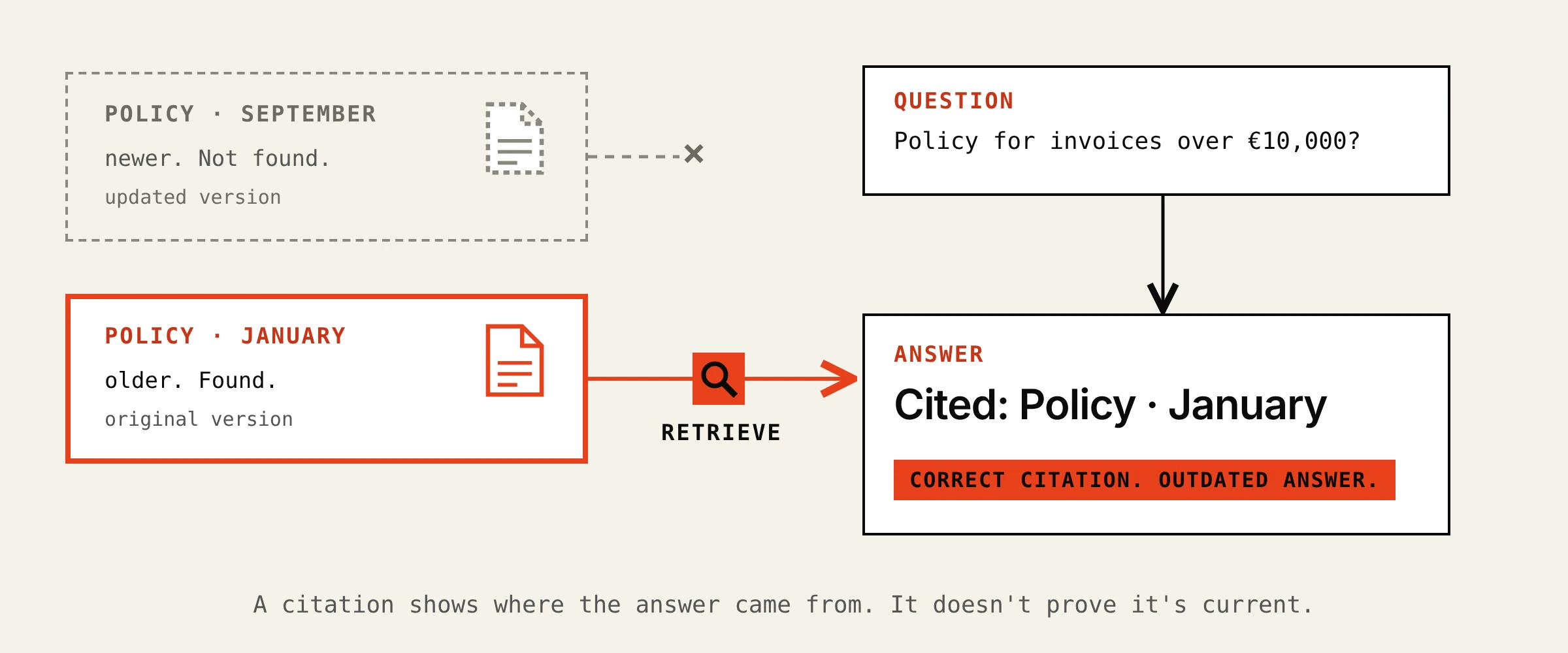
But suppose the company has two versions of the policy. One was written in January. Another was updated in September.
If the retrieval system finds the older document, the AI might provide an outdated answer and cite it correctly.
The citation tells you where the answer came from. It doesn't prove the policy is current.
Better search indexes, document metadata and retrieval methods can reduce this risk. Microsoft's Azure AI Search, for example, supports keyword, vector, semantic and hybrid retrieval.
But the underlying limitation remains.
RAG helps AI find information. It doesn't make that information correct.
And when the question involves business calculations rather than documents, another layer becomes important.
The semantic layer isn't new
Microsoft's recent AI announcements put a lot of weight on giving agents business context.
That might sound like a new problem.
It isn't.
Back in 2013, Joy Mundy at the Kimball Group was explaining why business intelligence systems need a semantic layer.
The problem was straightforward. Databases organise information in ways that make sense to systems and developers. Business users think in terms of customers, revenue, products and orders.
A semantic layer translates between the two. It gives technical fields understandable names, defines calculations and explains how different pieces of information relate to one another.
Power BI semantic models do much the same thing today.
Going back to our earlier example, suppose the business agrees that sales should only count completed orders.
Instead of allowing every report developer to create a different calculation, that definition can be built into a shared semantic model. Reports using the same measure then return consistent results.
That becomes especially important when AI agents start asking questions of analytical data.
Without trusted definitions, an agent might generate a technically valid query that answers the wrong business question. A semantic model gives it established calculations and relationships to work with, provided the agent is connected to that model and uses it correctly.
But there is an important distinction.
A semantic model cannot repair missing transactions, duplicate customers or incorrect source records simply by defining a measure. That work still belongs in the data engineering and data quality processes upstream.
We've spent years making data understandable to people. Now we're asking AI agents to understand it too.
The underlying problem hasn't changed.
Where Microsoft Fabric IQ fits
Microsoft is working on this problem too. Its own Fabric IQ announcement describes the usual approach to enterprise AI as "collect more data, add more tools, and hope models can reconstruct business context from inconsistent semantics scattered across systems."
Fabric IQ's answer is the ontology: a shared description of business things, such as customers, orders and shipments, and how they relate to one another.
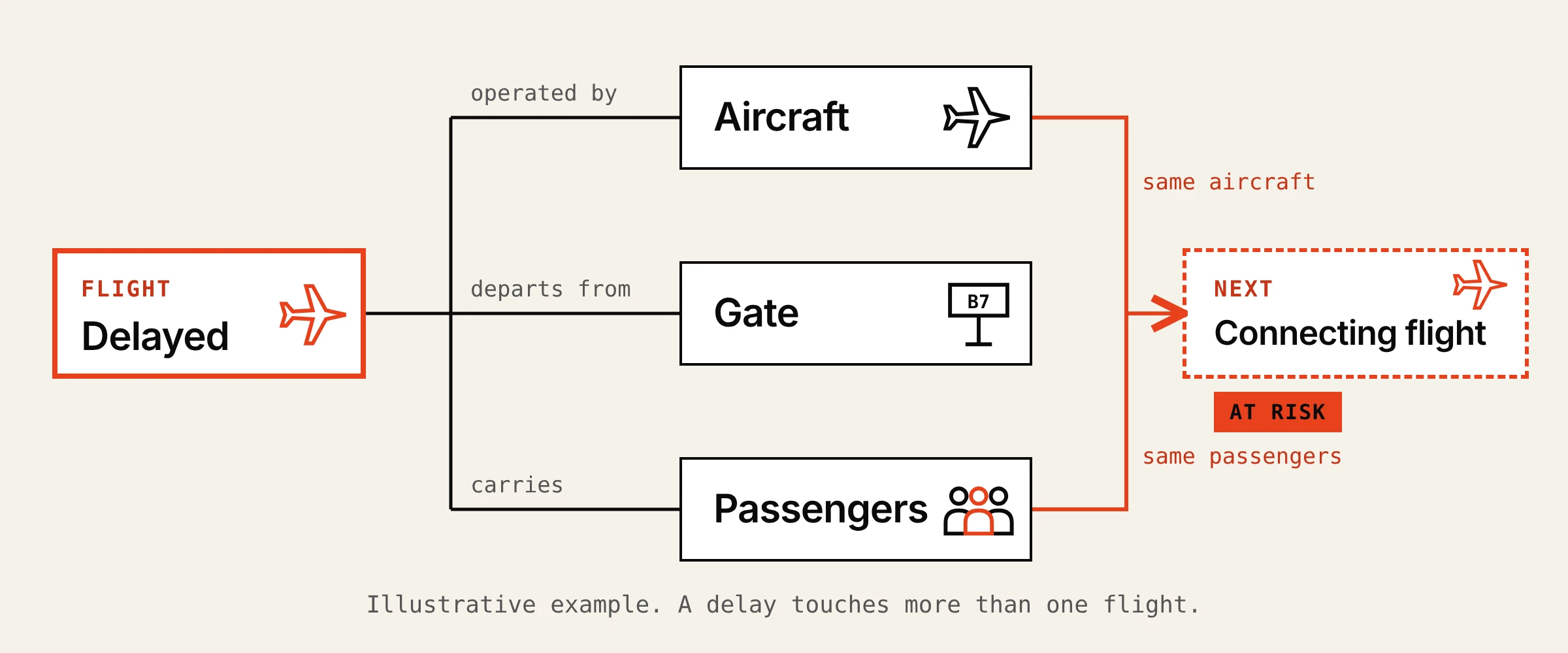
For example, an ontology for an airport might describe how flights, aircraft, gates and passengers connect. If a flight is delayed, an agent can then ask which aircraft is affected and which connecting passengers might miss their flights, not just report the delay.
Fabric IQ is designed to build on the Power BI semantic models you already have. That's sensible, with one condition. A layer built on your existing models starts from whatever those models say. If two reports calculate sales differently today, the disagreement is still there underneath.
At the time of writing (November 2026), Microsoft's documentation labels the IQ workload and the ontology as preview, so check the current status before planning around them. It also doesn't mean every organisation needs an ontology. For many businesses, the immediate challenge is much simpler. Their existing reports don't agree. Their data contains duplicates. Or nobody has documented how important metrics should be calculated.
Introducing another technology layer won't resolve those problems on its own.
What "correct engineering" means here
It isn't complicated. Before an AI agent can be trusted with your numbers, a few ordinary things need to be true:
- Each important number is defined once, in plain language, and agreed.
- It's calculated in one place, not rebuilt in every report.
- Checks catch missing or duplicate records before they reach a report.
- Someone owns each number and can answer for it.
- The rules are written down, so the next person (or agent) doesn't have to guess.
None of this is exciting. All of it decides whether the agent's answer can be trusted.
What should organisations do first?
Before investing heavily in AI agents, it is worth asking a few basic questions.
| If your problem is… | Start with… |
|---|---|
| Reports show different numbers | Agreeing on metric definitions and semantic models |
| Customer records are duplicated or incomplete | Data quality and integration |
| AI retrieves outdated documents | Document ownership, indexing and retrieval controls |
| AI can't link related records | Defining the relationships between your tables and business entities |
| AI answers sound plausible but can't be verified | Testing against known results and checking sources |
None of this is particularly new. Data teams have been working on these problems for years.
The difference is that AI agents make information easier to access and potentially easier to act on. That increases the importance of getting the foundations right.
An incorrect figure buried in a report might be questioned during a meeting. The same figure returned confidently by an AI agent could be accepted without anyone opening the underlying report.
That doesn't make AI inherently unreliable. It means verification, access controls and trusted definitions matter just as much as the model.
One clear takeaway
AI agents are changing how businesses interact with information.
RAG helps them retrieve relevant knowledge. Semantic models help define what business numbers mean. Technologies such as Fabric IQ aim to provide richer context about business entities and relationships.
These capabilities can work together. But none removes the need for accurate data, agreed definitions and proper governance.
For organisations already using Power BI or Microsoft Fabric, the best starting point may not be a new AI project. It may be improving the data models, pipelines and definitions they already have. Boring work, done properly, is what makes AI useful.
Better models make AI more capable. Better data makes it more useful.
Quick answers
Why do AI agents give wrong answers?
Usually because the data or definitions underneath are inconsistent. If two reports calculate "sales" differently, an agent can only pick one. It can't decide which is correct.
Why does AI give different answers to the same question?
It can draw on different reports, documents or calculations each time. Agreed definitions in a shared semantic model give it one answer to start from.
What should I fix before using AI agents?
Start with agreed metric definitions, duplicate or incomplete records, and who owns each number. A better model won't fix those.
Sources and further reading
- Microsoft Fabric Community Blog: Fabric IQ, the semantic foundation for enterprise AI
- Microsoft Learn: Fabric IQ overview
- Microsoft Learn: Azure AI Search and agentic retrieval
- Kimball Group: Making sense of the semantic layer