
The problem
Most businesses measure how many customers they acquired. Almost none measure how many they kept and what those customers were actually worth.
New customers are an event. A new contract signed, a new account opened, a new logo in the deck. It's the number that gets reported upward, that drives the acquisition budget, that fills the quarterly update. When growth is the story, acquisition is the headline.
What doesn't get measured with the same rigour is what's happening to the customers already there. How many left quietly last quarter. What they were spending. What it would cost to replace them. Whether the ones who stayed are buying more or buying less. These numbers exist somewhere in the CRM, in the finance system, in a spreadsheet nobody looks at but they rarely make it into a board-level metric.
The result is a business that pours budget into the front door while the back door stays open. Acquisition covers the gap. Until it can't.
Why it happens
Acquisition is visible. Retention is silence. And silence doesn't make it into the quarterly review.
A new customer is a moment a signature, a handshake, a contract. A retained customer is invisible. They just keep paying. There's no event, no announcement, no number that goes up. So retention never competes for attention in the same way acquisition does.
Finance teams compound this. They're trained to read totals, variances, and percentages against budget. Revenue up 12% year-on-year looks like progress. But if that growth is being driven entirely by new acquisitions while the existing base is quietly shrinking, the 12% is hiding a structural problem. The metric doesn't surface it because nobody built a metric to look for it.
The transactional mindset runs deep. Every customer interaction becomes a standalone event a sale made, a support ticket closed, a renewal processed. The cumulative value of that customer across their relationship with the business never gets calculated. As Rory Sutherland put it on The Bottleneck Podcast: the CFO is running an escort agency when the customer wants a marriage. Every transaction is optimised in isolation. Nobody is measuring the relationship.
What the fix looks like
Conny Kalcher took this problem into one of the least customer-centric industries in the world and built a metric that made finance listen.
Kalcher joined Zurich Insurance as Group Chief Customer Officer in 2019, having spent over three decades at LEGO. Her brief was to shift one of the world's oldest insurers from a transactional model to a loyalty-led one. The first problem she encountered wasn't culture or technology. It was measurement. The business didn't have a number that connected customer behaviour to financial outcomes.
Her solution was to build one in partnership with the CFO. Not to sell the finance team on softer metrics, but to co-create a measurement in the language they already spoke. The result was Net Revenue Retention.
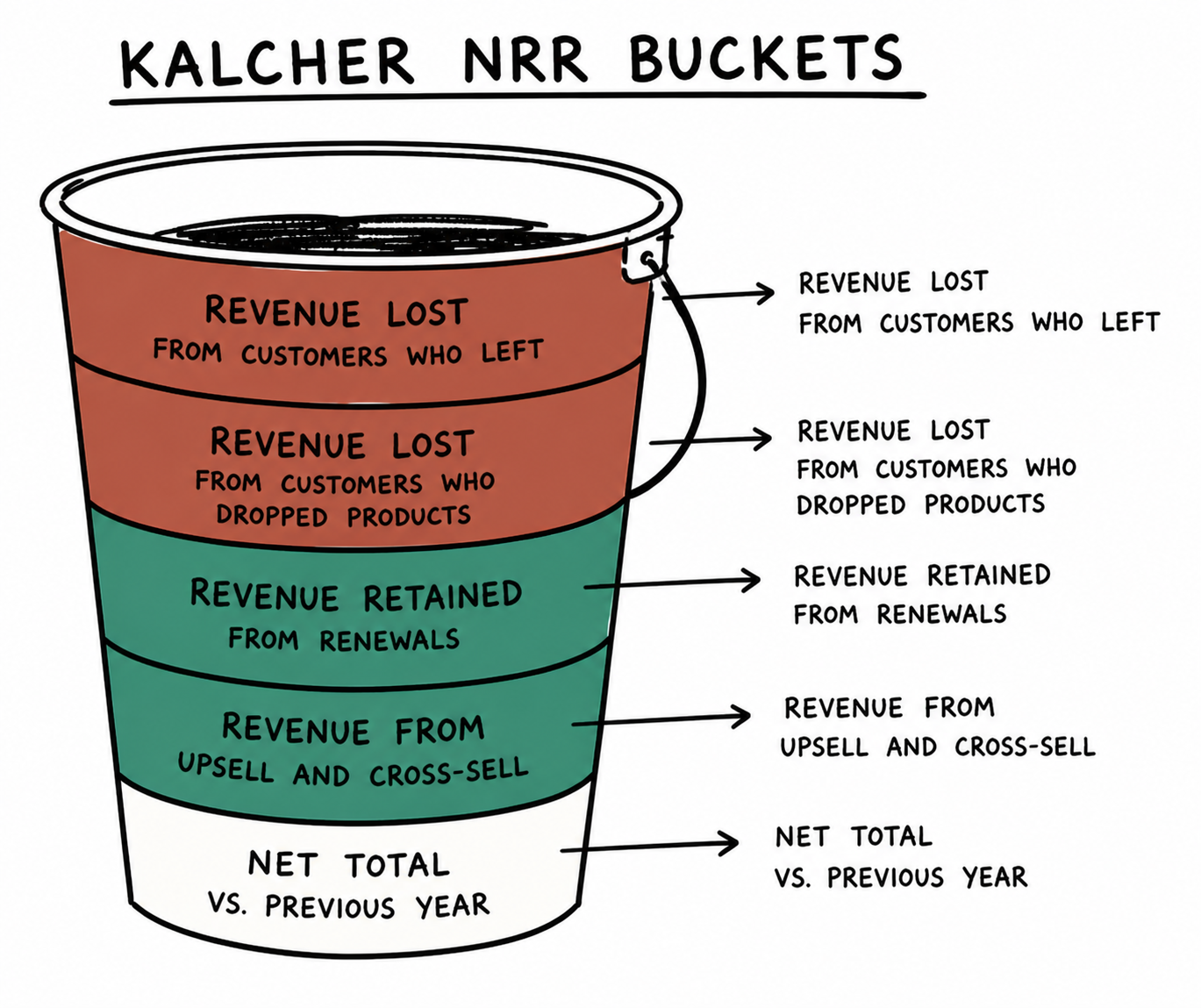
NRR breaks the existing customer base into five buckets:
Revenue lost from churned customers customers who left entirely, gone from the base. Revenue lost from dropped products customers who stayed but reduced their spend. Revenue from renewals the base that held. Revenue from upsell and cross-sell existing relationships that expanded. Add it up, compare it to the previous year, and you get a single number.
Above 100 loyalty was created. Below 100 loyalty was lost.
That number becomes the basis for a conversation finance can actually join.The Zurich internal model found that a 1% increase in customer retention translates to a 0.5% increase in revenue. That is the number that opens a CFO's ears. It converts the abstract case for customer loyalty into a figure the business can model, forecast, and act on.
The cross-sell finding is particularly instructive. Zurich found that customers holding both life insurance and car insurance stayed longer for both even though car insurance is a commodity product that normally triggers price shopping. Depth of relationship changed price sensitivity entirely. The customer stopped shopping around not because they were locked in, but because the relationship was worth more than the saving.
This is exactly the kind of insight that disappears inside a standard acquisition-focused report. It only appears when you measure the customer not the transaction.
The framework applies well beyond insurance. Any business with a recurring revenue model, a loyalty programme, or a service relationship has the underlying data to run this calculation. The gap is almost always in how that data is structured and reported not in what's being collected. For more on how BoringBI approaches this for SMEs, see the industries we work with.
One clear takeaway
Acquisition tells you how good your marketing is. Retention tells you how good your product is. NRR puts a single number on the difference and makes it a conversation finance can actually join.
Is your reporting telling you the full story?
If your metrics stop at new customer counts, you're missing the data that actually drives long-term revenue. A free discovery session no pitch, no commitment. Just a clear look at what your data is and isn't telling you.
Get startedThis post draws on notes from The Bottleneck Podcast Rory Sutherland and Elfried Samba in conversation with Conny Kalcher, Group Chief Customer Officer at Zurich Insurance. Additional sources: CX Network interview with Conny Kalcher; The Candid CMO, WFA.