
The problem
When efficiency becomes the purpose, the business starts consuming itself.
Cost reduction is fast, measurable, and easy to defend in a meeting. It shows up immediately in a report. Finance gets a clean number. So it becomes the default brief for operations, for strategy, and quietly, for the data function too. Dashboards get built around what's already being cut. Reporting gets oriented around efficiency metrics. And gradually, without anyone deciding it, the entire analytical output of the business points inward.
Peter Drucker identified this decades ago. The purpose of a business, he argued, has only two functions: marketing and innovation. Everything else is a cost. Efficiency is not a purpose it's a tool. When it becomes the purpose, the business starts consuming itself. If any business continued to do what made it successful in the past, Drucker warned, it would ultimately fail. The logic that says "keep doing what worked" is exactly the logic that traps a business in decline.
The dominant approach especially among publicly traded companies has become a business efficiency competition. Every quarter, every cost line scrutinised, every function evaluated for what can be cut. This competition has no finish line and only one direction of travel.
Why it happens
Rory Sutherland called it the Doorman Fallacy. It's everywhere.
In his 2019 book Alchemy, Sutherland described what happens when a business consultant evaluates a hotel doorman. The consultant sees someone standing by an entrance, occasionally opening a door. On that basis the role looks automatable a sensor and a motor costs less than a salary. Cut it. Save the money.
But this strips away everything the doorman actually does: welcoming guests, hailing taxis, enhancing security, discouraging unwelcome behaviour, giving regulars personalised attention. The mere presence of a doorman changes how guests perceive the quality of the hotel. None of that appears in a cost model. So it gets removed along with the value it was silently carrying.
Two forces deepen the problem. The first is reductionism numbers that go down are easier to explain than insights that don't yet have a number. A 4% reduction in cost-per-unit is a result. An unusual pattern in customer behaviour that might indicate something is a conversation. One survives a quarterly review. The other doesn't.
The second is career incentive. It is significantly easier to be fired for a bold idea that didn't work than for an unimaginative one that delivered marginal gains. So the rational individual move is to keep optimising what already exists. The collective result is an organisation that has automated itself into a corner.
What it looks like in practice
The cost saving gets claimed. The destruction of value does not.
The self-checkout till is the clearest example most people will recognise. The original rationale was sound give customers an option, reduce queue times, improve experience. Finance spotted that self-checkout costs less per transaction than a staffed till. So the option became an obligation. Staffed tills disappeared. The cost saving got claimed.
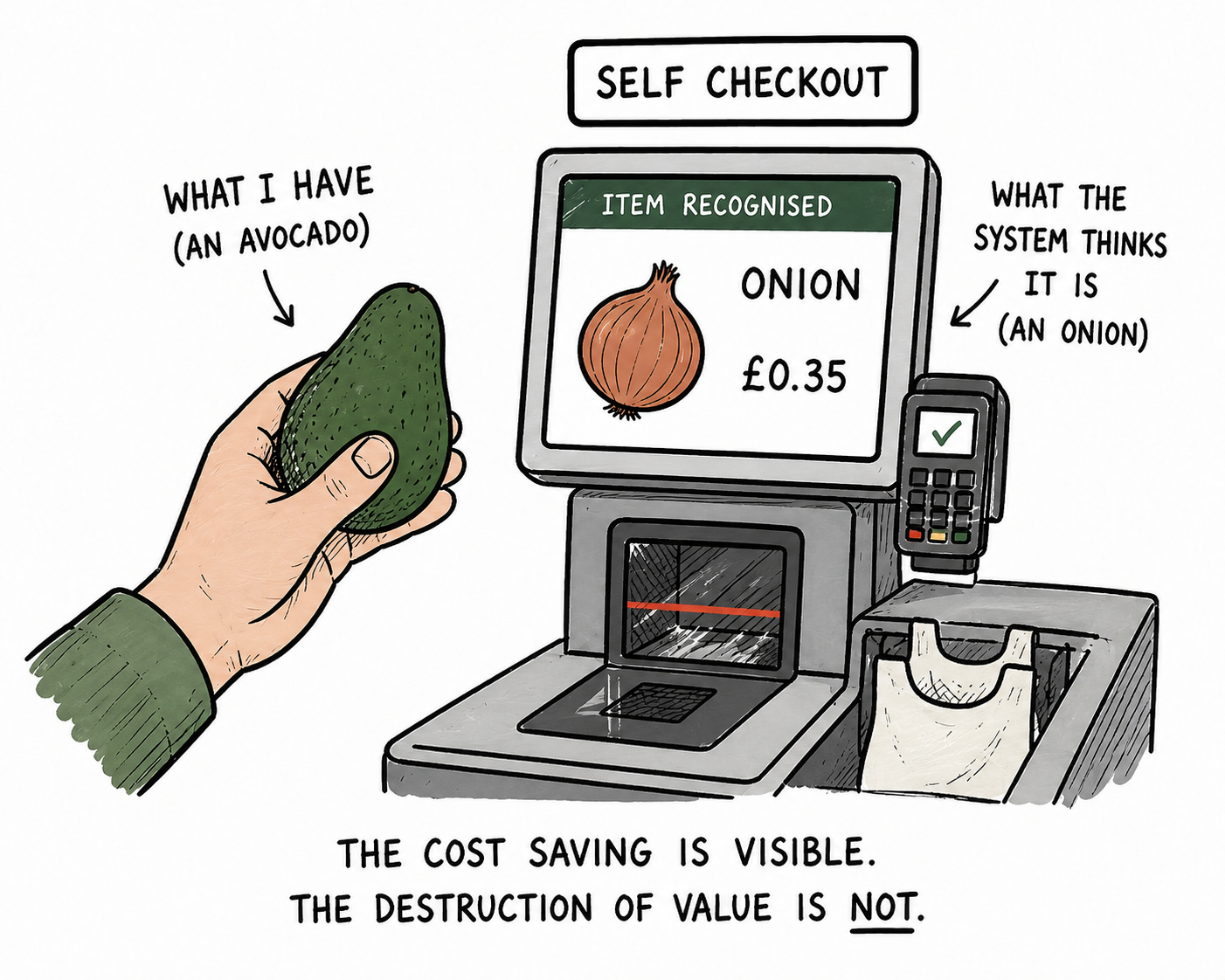
What didn't get claimed was accountability for what followed. A significant surge in shoplifting. Customers scanning avocados as onions. Large family shops becoming genuinely difficult to complete. The cost reduction was visible and measurable. The destruction of value was not so nobody owned it.
The same pattern plays out when AI is deployed primarily as a headcount reduction mechanism. Taco Bell rolled out voice AI across its drive-throughs, faced a barrage of customer complaints, and its chief technology officer subsequently conceded that human staff might handle things better, especially during busy periods. A recent Orgvue report found that up to 55% of companies that replaced employees with AI now acknowledge they moved too quickly. Some are rehiring the people they let go.
55% of companies that replaced employees with AI now say they moved too quickly.
Source: Orgvue, 2025. Some are rehiring the people they let go.Human experience trumps efficiency in more situations than the cost model accounts for. The value being destroyed trust, service quality, conversion, relationship depth rarely has a line in the report. So it never gets weighed against the saving.
What the fix looks like
The businesses that compound over time stayed curious. They kept explore bees.
Sutherland described the alternative using bees. A healthy hive maintains a ratio of exploit bees following known pollen and explore bees ranging out to find new sources. Without the explore bees, the hive cannot get lucky. It can only become marginally better at what it already does. "If you don't invest in exploration," Sutherland argues, "you become over-optimised and trapped in a local maximum."
The purpose of a business is to continuously explore and discover in a Darwinian way new sources of adjacent value creation. That is investigative, imaginative, creative and exploratory. A reporting function built entirely around cost reduction produces the opposite of that.
The data function needs a dual brief not just to measure what's already happening, but to surface what isn't yet on the agenda. That means preserving granular data rather than aggregating it into summaries that confirm existing assumptions. Building reports that flag anomalies, not just totals. Treating an unexpected finding as a result worth pursuing rather than an outlier to explain away.
This doesn't require a large team or an expensive platform. It requires a different question at the start of the engagement not "how do we report on what we're already doing?" but "what would we want to know that we currently can't see?" For more on how BoringBI approaches this, see the industries we work with and the previous post on NRR a metric built on exactly this kind of question.
One clear takeaway
Efficiency tells you how well you're doing what you already do. It has nothing to say about what you should be doing instead. The businesses that compound over time are not the most efficient ones. They are the ones that stayed curious.
Are your dashboards only ever confirming what you already suspect?
If your reporting points inward and only measures what's being cut, you're missing the data that drives growth. A free discovery session no pitch, no commitment. Just a clear look at what your data is and isn't telling you.
Get startedThis post draws on Rory Sutherland's Alchemy (2019) and The Bottleneck Podcast. The explore/exploit framework originates in behavioural science and operations research. Taco Bell example sourced from the Wall Street Journal. AI redundancy stat from Orgvue.